ardelvo.

GPUs & AI accelerators

A wider view of compute: professional GPUs, dedicated AI processors and cloud platforms. Choose the software and deployment model as carefully as the silicon.

A GPU is a programmable parallel processor used for graphics and compute. An AI accelerator may use a more specialized design. They can solve overlapping problems, but their software, deployment and purchasing models differ.

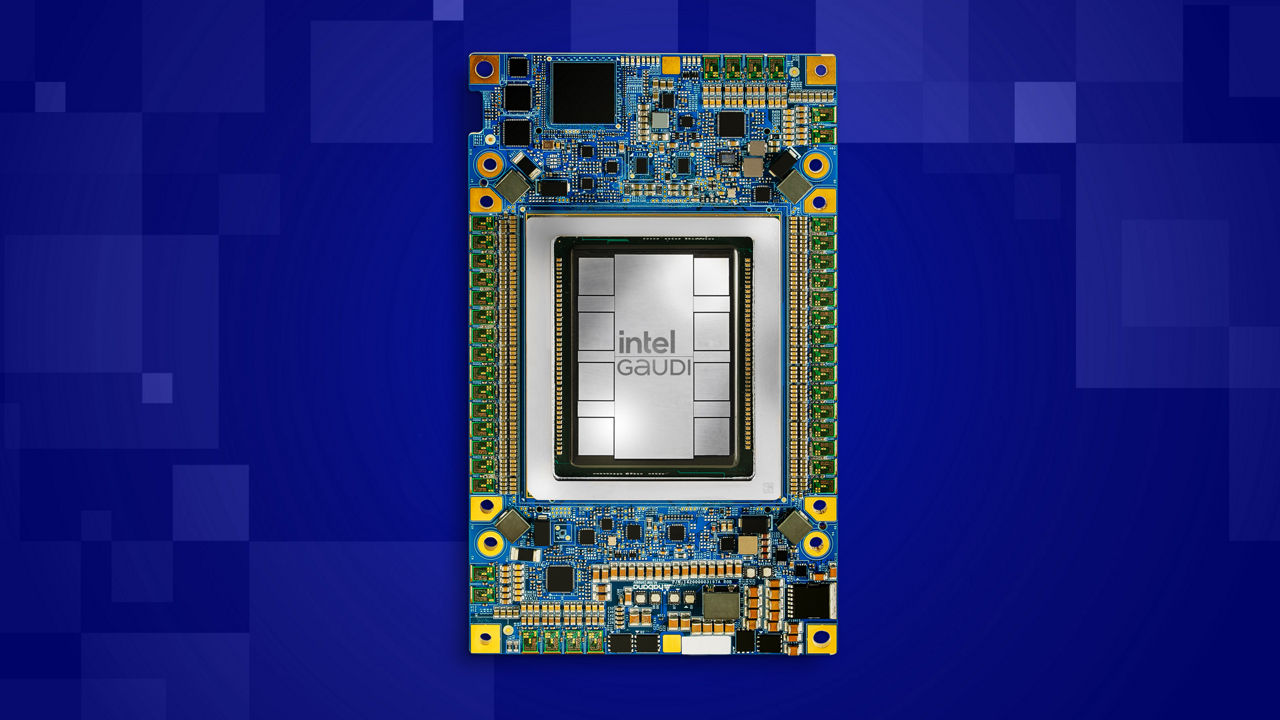
Intel Gaudi 3 AI accelerator
Intel Gaudi 3 AI accelerator · Image courtesy of Intel. Manufacturer source

Intel: professional graphics and dedicated AI

Intel Arc Pro B60

Arc Pro B60 offers 24 GB of graphics memory. It is a professional GPU option to evaluate for workstation graphics and local AI workloads, rather than a direct substitute for a rack-scale accelerator system.

  • Check application certification and driver support.
  • Confirm chassis clearance, board power and display needs.
  • For local AI, test the intended model and inference runtime.
Intel B60 datasheet

Intel Gaudi 3

Gaudi 3 is a dedicated AI accelerator, not an Arc graphics card. Intel specifies 128 GB HBM2e memory and 3.7 TB/s memory bandwidth, with Ethernet-based scale-out connectivity.

  • Evaluate the supported framework and software release.
  • Test model operators and distributed communication.
  • Compare the complete server configuration and support path.
Intel Gaudi platform

Other approaches to AI compute

Cerebras CS-4 / WSE-3T

Cerebras announced CS-4 in August 2026. Its WSE-3T uses a wafer-scale design with 900,000 AI-optimized cores and 44 GB of on-wafer SRAM. This is a dedicated system architecture, not a PCIe GPU card.

Evaluate supported models, system or service access, data movement and deployment terms. Do not compare its core count directly with GPU cores.

Cerebras CS-4 announcement

Google Cloud TPU

Google’s TPU family is designed for machine-learning workloads. TPU v6e, also called Trillium, has documented slice configurations and training workflows through Google Cloud.

Check framework support, region, quota, compilation behavior and the cost of data movement. A TPU cloud deployment has different operational requirements from owning GPU servers.

Google TPU v6e architecture

AWS Trainium2

Amazon EC2 Trn2 instances provide access to Trainium2 AI accelerators. The instance shape determines accelerator count, host memory, networking and local storage.

Review the AWS Neuron software path and run a representative training or inference job before sizing a commitment.

AWS Trn2 instance configurations

NVIDIA and AMD

Our platform overview covers Blackwell Ultra B300/GB300, AMD Instinct MI355X, Vera Rubin and AMD Helios. It explains how server and rack-scale configurations change the infrastructure plan.

Explore NVIDIA & AMD platforms

Compare the deployment, not just the chip

Platform typeUseful starting pointWhat to verify
Professional GPUWorkstation graphics, local AI and developmentApplication support, graphics memory, drivers and chassis
Data center GPUServer-based training, inference and computeGPU topology, framework support, memory and network
Dedicated AI systemSupported models on a specialized architectureCompiler/runtime, model coverage and deployment terms
Cloud acceleratorManaged access without installing local hardwareRegion, quota, instance economics and data location

Use your own model, precision, sequence length and concurrency when benchmarking. Record latency, throughput, memory use and total operating cost together.

Planning a hardware change?

Send us your workload, platform and site requirements.

Discuss your project

Manufacturer references reviewed 13 September 2026. Examples are informational, not a statement of stock, resale authorization or guaranteed compatibility. Confirm the exact SKU and platform documentation with your supplier.